
Why have certain beliefs and ideologies (for example, the doctrine of hell) persisted throughout history, where others have failed? In our last post, we talked about how the location of a particular society can have an uncanny effect on what that society holds as ‘truth’. The relative isolation and anti-Roman sentiment of third-century Northwest Africa, for instance, made it a natural source of harsh, ‘us versus them’ conceptions of hell and the afterlife. The fact that the region’s key writers produced their works in Latin was a quirk of fate that made them more appealing and enduring within the influential Western half of the Roman Empire (including Rome itself).
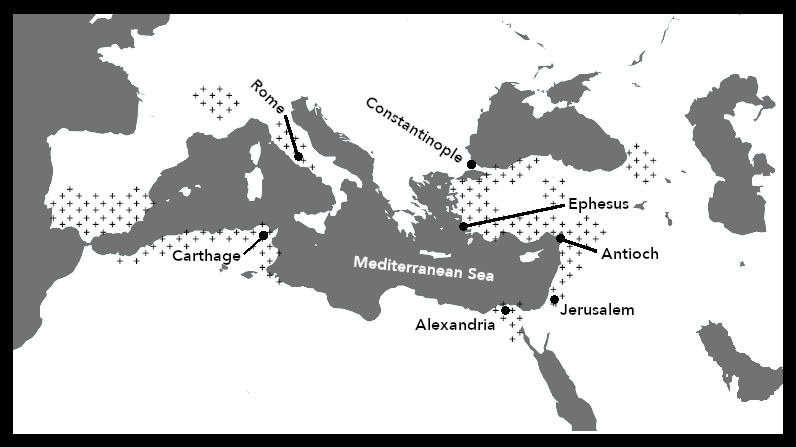
The Northwest region of Africa was not the only big player in early Christian ideology, however. Alexandria, once a pet favourite of Alexander the Great, had persisted under Roman rule as a centre of philosophical and intellectual sophistication, culture, and learning (not to mention wealth and trade!). This is perhaps symbolised most strongly by the famous Library of Alexandria. It is unsurprising, therefore, that this culturally prominent city would produce several important Christian scholars. While Northwest African writers like Tertullian were railing against philosophers and painting grim pictures of hell’s torments, though, key Alexandrian Christians were coming to very different conclusions about the afterlife.
Clement, Origen, and Alexandrian Christianity: A Hopeful Afterlife
Like many Christian writers of his era, Clement of Alexandria was a highly educated convert to the faith. Rejecting the pagan beliefs of his family, Clement travelled across the Roman Empire, seeking to learn from various leading thinkers. Around AD 170-180, he settled in Alexandria, having finally found a truth he was satisfied with. Following the death of his teacher Pantaenus in AD 190, Clement adopted Pantaenus’s role as the leading Christian teacher in Alexandria.
Clement wrote with great hope about the afterlife, and immortality was one of his favourite themes. Immortality, of course, would be given to all who loved God. There was hope, however, even for those who had rejected God. Any soul in Hades who repented would be saved. The punishments of Hades, Clement argued, were not final: “God’s punishments are saving and disciplinary, leading to conversion, and choosing rather the repentance than the death of a sinner.” Souls being punished in Hades would have a much clearer view of reality now that the distractions and deceptions of their bodies had been taken away — it was only natural to expect that many such people would see the error of their ways, and therefore be permitted to enter heaven.
Clement also believed in a kind of punishment for Christians who had committed sins after they had been baptised. This issue was a confusing one for early Christians. Some believed that if a person sinned after being baptised, there was no hope of forgiveness — they were permanently condemned to God’s judgment. Others believed that a baptised Christian could sin once or twice and still return to God. Some Christians superstitiously avoided being baptised until they were on their deathbed to make sure that they couldn’t possibly sin afterwards! Clement addressed this problem by stating that baptised Christians could be purified of their sins through some sort of temporary suffering in the afterlife.
If souls in Hades could escape by following God, would everybody eventually choose to enter heaven? If not, what would happen to those who refused? On this point, Clement’s opinion is unclear. On the one hand, he talked about “destruction”, seeing it as an event which is different to Hades. Souls in Hades who refused the preaching of Jesus and the apostles, Clement wrote, would be like “persons who have thrown themselves voluntarily from a ship into the sea”; they have “abandoned themselves to destruction”. This seems to imply that people in Hades might eventually reach a point of no return, at which time God would mercifully end their existence. In other writings, however, Clement insisted that God would save all people, some voluntarily, some through the use of punishments.
***
Origen was Clement’s most brilliant student. Born into a Christian household, Origen rapidly advanced in his knowledge and spiritual devotion. His talent was recognised early on — at the mere age of seventeen, he became the head of Alexandria’s school for new Christians. Like Clement, Origen roamed widely in a quest for further knowledge. He learnt from the best minds the Roman Empire had to offer, Christian and pagan alike.
Aside from a few basics (for example, that physical bodies would be resurrected and reunited with souls), Origen said that church teachings about the afterlife were vague and unclear. What, he asked, is the soul? Where does it come from? Do people’s souls begin to exist at the same time as their bodies? Did they exist separately to their bodies? Were they placed in bodies by God? What existed before this world? What will exist after this world? Where did the devil come from? What, exactly, are angels, and when did they begin to exist? Origen sought to explore these questions, hoping to provide the answers that were currently lacking within Christianity.
Origen took a cautious approach towards these topics — he was careful to emphasise that his exploration of these questions was one of “investigation and discussion”, rather than one of “fixed and certain decision”. Despite this modest attitude, however, his conclusions were bold and provocative.
Humans, angels, and even the devil, he theorised, were all originally created with the same nature — the nature of a rational being, capable of both good and evil. Beings which followed God completely, always choosing the good path, became known as angels. Other beings fell away from this path, some to a small degree, some to a greater degree. These beings became humans. As for the ‘fallen angels’, they were beings who “sunk to such a depth of unworthiness and wickedness” that they were not seen as worthy of taking part in the human race. These evil beings are still capable of doing good (because all rational creatures, Origen argued, have the capacity for both good and evil). Nevertheless, they neither desire good nor seek after virtue, but instead utterly embrace evil.
Human existence, according to Origen, is a process of “training and instruction”. Depending on their varying levels of evil and fallenness, humans would proceed through a series of punishments and trials. Through these trials, humans would gradually advance to higher and better states of existence. The more a person had fallen from their original state of being, the longer and more severe the punishment — not because they deserved to be punished, but because greater trials were necessary to instruct them back to the good path. Some of these trials, Origen stated, would happen in the present world, while others would happen in the “eternal world” of the afterlife.
Origen rejected the idea that the “everlasting fire” was some sort of location that sinners would be thrown into. Instead, he viewed this ‘fire’ as more of a psychological punishment, where a person’s mind and conscience would be given the ability to perfectly remember their entire history of evil. The weight of these remembrances would inflict suffering and punishment on their soul. This self-punishment would be like a purifying fire, “healing” a person by burning away any of their defects.
Whether the trials occurred now or later, the path of humans would be to advance through the various levels of the angels, finally reaching a “condition of perfect spirituality”. Every rational being would be capable of this journey, since all rational beings possess the power to choose either good or evil. It was possible that God, through Jesus Christ, would restore all of his creatures — even his enemies. Origen rejected the idea that souls could be so corrupted that they would “forget their rational nature and dignity, and sink into the condition of irrational animals”. Rational souls would always remain rational. Therefore, it was possible that even the devil could be “converted to righteousness” in the future world.
***
An influential and popular figure to Christians living in the eastern half of the Roman Empire, Origen would eventually meet a grim fate. In AD 250, the Roman emperor Decius began an empire-wide program of imprisonment, abuse, and murder of Christians. Origen was arrested and tortured, eventually dying in 254.
Origen was a polarising figure long after his death. For many in the eastern half of the empire, he was beloved. Students of Alexandria such as Theognostus, Pierius, and Pamphilus devoted themselves to Origen’s teachings and adopted similar views. As well as his teachings, Origen was respected for his lifestyle and for his death as a martyr.
At the same time, however, a deep hatred of Origen’s writings started to emerge. Some of this was due to Origen’s speculations about the soul and the possible salvation of the devil. The rise of Arianism was another factor. Arianism involved the belief that Jesus was made by God, that he had a beginning, and that he was not equal to God. Arius, who invented this theory, was heavily influenced by Origen (as were many Christians in the East). Origen’s views were different to Arius’s; nevertheless, Origen’s name became connected with Arianism.
As for what happened next — the battle for Origen’s legacy and reputation, the controversy and confusion surrounding Arianism, and the ideological struggle between a never-ending hell and universal salvation — such matters will have to wait, unfortunately, for another time.
This is a modified excerpt from my as-yet-unreleased book, Decoding Gehenna: Hell and the Afterlife in the West. Subscribe or Follow Me for updates and more sneak-peek excerpts!
