
Why have certain beliefs and ideologies (for example, the doctrine of hell) persisted throughout history, where others have failed? An idealist may argue that such survival is based on merit, and that it is always the most worthy ideas which endure. A cynic might claim that the great ‘battles of ideas’ are dictated by power — that is, by whoever has the biggest guns, the most money, or the best connections. Curiously, though, there is another factor at play, one that humans are often blind to: the unique quirks and values of specific societies (or, to put it more simply, location).
For a contemporary example, one needs look no further than the classic American traits of entrepreneurialism, innovation, and business-mindedness; anyone who has spent time behind the curtain of 21st-century evangelical Christianity will testify to the growing prevalence of marketing campaigns, TED Talk-esque keynote speeches, boards of directors, strategic plans, and so on. At the other end of the scale is the development of explicit atheism in the 18th century, a phenomenon which was particularly centred in Paris, and which contrasted with more widespread European positions such as deism or agnosticism. (Unfortunately, my lack of detailed knowledge about French culture precludes me from speculating exactly why this was the case.)
Location was just as critical to early Christian notions about hell and the afterlife. The location (or, rather, locations) of interest for today’s post are not, however, to be found in Europe, America, or even the Middle East. Instead, our focus turns towards two regions of Northern Africa: the Northwest (known for the ancient city of Carthage), and the Northeast (more precisely, the city of Alexandria). From the end of the second century AD onwards, these Roman territories would produce important authors such as Clement of Alexandria, Origen, Tertullian, Minucius Felix, Cyprian, and (eventually) Augustine of Hippo. Ideologically, the two regions were polar opposites, and the ideas they birthed would go on to slug it out for centuries to follow.
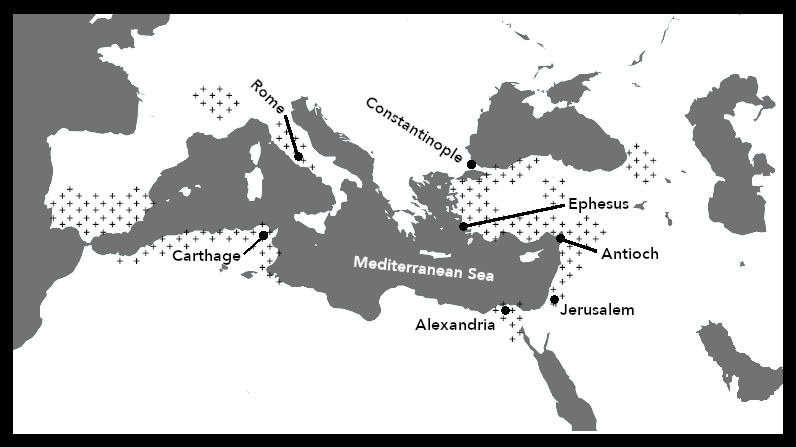
Alexandria, a pet favourite of Alexander the Great, became a leading centre of philosophical and intellectual sophistication thanks to Alexander’s love of culture and learning. When the Romans captured Alexander’s territories, Alexandria maintained its status as a meeting place for philosophical and religious ideas of every variety.
Carthage, once the wealthiest city in the Mediterranean, was never part of Alexander’s empire. It could not, however, withstand the ambitions of the Roman Empire. Carthage, like Athens and Alexandria, became a sign of Roman dominance over a previous world power. A power struggle between Carthage and Rome was settled decisively in 146 BC; Carthage was burnt to the ground and replaced with a Roman colony, an important foothold in the relatively isolated region of Northwest Africa.
Tertullian, Hell, and the Northwest: Christianity versus the World
Christianity in Northwest Africa was not known for its philosophical leanings — quite the opposite. Instead, it was a “religion of protest… puritanical in outlook and sectarian in attitude”, trademarked by a hostility towards philosophy, paganism, and Roman authorities. Christians isolated themselves from society, longing for the day of final judgment and the obliteration of their enemies. This “reputation for conspiratorial activity and opposition to pagan Roman society” proved to be quite attractive to those who were likewise sceptical of the empire. (Quotations courtesy of The Cambridge History of Africa, Volume 2, pp454-455).
One of Carthage’s leading writers of this period was a man named Tertullian. In keeping with the mood of Northwest African Christianity, Tertullian’s writings were aggressive and gruff, holding Greek philosophy in scathing contempt. Socrates, he wrote, was a disturbed mind and was influenced by a demon. Philosophers infected truth with “poison” and “noxious vapours”. Any real truth that philosophy produced was “through blind luck alone”. “Heathen writers”, said Tertullian, offered nothing of value to any Christian.
For Tertullian, truth was simple. All truth comes from God. God reveals truth through the Christian scriptures, as well as directly to the soul. The Christian belief, through its Jewish roots, was more ancient than any philosophical writings. Therefore, Tertullian argued, absolute truth belongs to Christians alone. Philosophers could take no credit for any enlightenment their readers might gain. They owed all of their good ideas to the original “fountain” of truth, God.
It was up to Christians, Tertullian argued, to clear away the “noxious vapours” by “shattering to pieces” the arguments of the philosophers. Christians should oppose the philosophers with “heavenly wisdom… revealed by the Lord”. Christians, Tertullian claimed, did not need to rely on extensive arguments or discussions. Instead, only a few words of scripture were needed for a Christian to understand an issue with absolute certainty. (Ironically, Tertullian’s philosophical discussion on the nature of the soul spanned 47,000 words and fifty-eight chapters; his thinking, meanwhile, was heavily influenced by the Greek philosophical tradition of Stoicism.)
Tertullian’s conclusions regarding the soul were relatively unique. Like the Stoics, Tertullian argued that the soul was “corporeal” (or physical). This contrasted with most other philosophers (whether Christian or pagan), who by this point maintained that the soul was non-physical. If the soul were to be removed from the body, Tertullian said, it would have the shape of a human figure. A soul would have an “ethereal”, “transparent” colour, since “its material nature is wind and breath”. Furthermore, it would be capable of feeling and sensing.
In regards to the afterlife, Tertullian said that upon death, a person’s soul would reside in Hades, a “vast deep space in the interior of the earth”. In the “bad” region of Hades, wicked souls would experience suffering and torment; in the “good” region, righteous souls would experience peace and joy. In Hades, souls would not age — they would stay at the same age as they were when they were separated from their bodies. On the day of judgement, souls would be released from Hades and reunited with their resurrected bodies.
Tertullian’s version of the final judgement was most strongly provoked by the spectacle of the Roman circus. For a strict moralist like Tertullian, the circus (or sporting arena) represented everything he despised. To Tertullian, the arena was an environment of pure moral depravity. It provoked people to lewd acts. It exposed innocent minds to foul language and conduct. It stirred even the most self-controlled person into a state of “passionate excitement”. It allowed actors to make fools of themselves. It paraded “harlots” for the audience’s viewing pleasure. It condoned horrific violence and death in the name of entertainment.
On the final day of judgement, Tertullian gleefully wrote, the tables would be turned. Tertullian imagined a day where he would be like the crowds of the circus — not enjoying the spectacle of athletic competition, but rather the spectacle of fire and torment. All the emotions of the arena would be his — admiration, derision, joy, exultation. He would drink in the entertainment as monarchs, governors, philosophers, poets, actors, charioteers, and wrestlers all suffered in the flames of judgement. This fire, he wrote, would be “without ending and without break”.
Tertullian is thought to have been the first Christian to write in the language of Latin. Greek was the dominant language used for writing in the eastern part of the empire (and was the original language for what would later be known as the Christian New Testament). Latin, on the other hand, was commonly used in writings produced in Rome and in the western part of the empire. Perhaps owing to this fact, as well as the extensive and persuasive nature of his writings, Tertullian would prove to be a key influence on future Christian thinkers from the Latin-reading West.
The other person with a claim to being the first Christian writer in the Latin language was Minucius Felix. Minucius is known for a single surviving piece of writing, The Octavius, in which he wrote vividly about the torments of the afterlife, taking inspiration from Greek poetry. In one example, Minucius described how the
In other words, the fires of hell possessed some sort of magical quality, in that they would make bodies grow and re-form while simultaneously burning them up. Minucius had no qualms about stating that this never-ending horror would be deserved by the sufferers. Ignorance of God, he argued, is just as bad as offending God — and “ignorance of God is sufficient for punishment”.
Cyprian, meanwhile, was upper-class, rich, and famous. He shared Tertullian’s disgust of pagan society, which led him to convert to Christianity in his forties. He gave away much of his wealth, and quickly became an influential figure in the Carthaginian Christian community. Within a few years, he was elected as the bishop of Carthage.
While the bishops of Rome, Antioch, and Jerusalem were executed in the persecutions of AD 250, Cyprian avoided their fate by going into hiding. Understandably, his writings became filled with the issues of persecution and martyrdom. He encouraged Christians to stay loyal to God and not abandon their faith when threatened with torture and death. The persecutors, he wrote, would be sentenced to Gehenna (since Cyprian was writing in Latin, he did not use the Greek word Hades). In Gehenna, they would suffer the “perpetual burning of a penal fire”. The weapons of torture could not conquer “invincible faith”; instead, the flowing blood and “glorious gore” of the martyrs would “subdue the flames of Gehenna.”
According to Cyprian, Gehenna would feature many different degrees of punishment. These varieties of torment bore an interesting resemblance to those depicted centuries earlier in Greek religious texts:
***
The positions of Tertullian, Minucius Felix, and Cyprian — along with the Northwest’s “puritanical” and “sectarian” attitudes — are perhaps recognisable in many present-day expressions of Christianity. While Northwest African Christianity was not alone in its endorsement of an inescapable, brutally vivid hell, the influence of its writers on the Western Roman Empire (including on Rome itself) is unmistakeable. As for the other side of the coin — the comparatively curious, polite, and well-travelled Christianity of Alexandria — well, that’s a discussion for another time!
This is a modified excerpt from my as-yet-unreleased book, Decoding Gehenna: Hell and the Afterlife in the West. Subscribe or Follow Me for updates and more sneak-peek excerpts!
petedunnwords.com will be on hiatus until the new year. I wish all my readers a safe and happy holiday season 🙂
