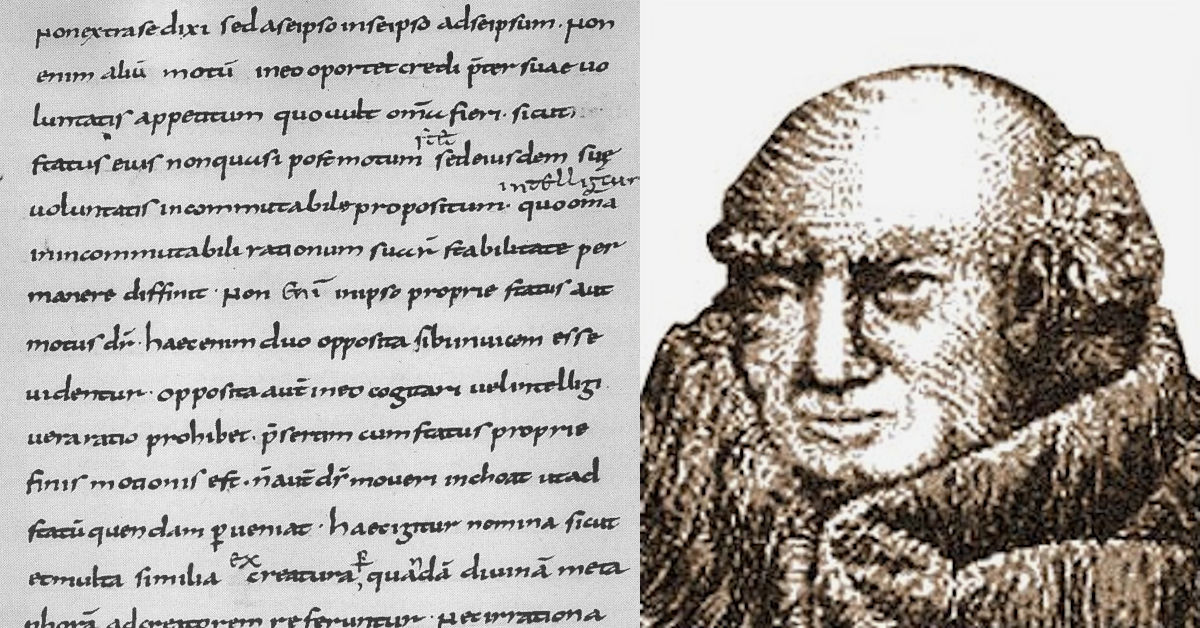
If there’s one thing I’ve learnt from studying Western religious history, it’s this: Christians seem to have an uncanny knack for picking fights and stoking controversies with other Christians. (Perhaps this is true of all religions and ideologies; the scope of my research must, however, remain confined to the Western world). In any case, choose any century at random from the past 2000 years and you’ll inevitably find some sort of juicy Christian stoush to unearth. Last time, I wrote about 17th century England and Isaac Newton’s anti-trinitarianism; today, we’re looking at 9th century Francia (that is, the kingdom of the Franks).
Before we get started, though, a little backstory is required.
To understand the story of Eriugena, Hincmar, and Gottschalk, it’s essential to first grasp the significance of Augustine of Hippo. To keep things brief (as Augustine is not the chief subject of today’s post): Augustine was a Christian leader and philosopher from the 4th and 5th centuries whose ideas would prove to be both popular and groundbreaking — perhaps more so than any other writer of his time. Among his concepts was something called double predestination; essentially, Augustine argued that God’s decision, and God’s decision alone, decided who was ‘saved’ and who was not. If you wound up spending eternity with God, it was because God chose you to be there. If you spent eternity in hell, it was because God chose you to be there. In either case, human freedom of choice played no part whatsoever.
Augustine achieved legendary status, and many of his ideas became quickly entrenched within early medieval Christianity. Some of his ideas, however, became toned down as the centuries went on — one of them being ‘double predestination’. Influential pope Gregory the Great, for example, maintained that free will was real, and that people could genuinely choose whether or not to follow God. God would not force any person to go to heaven or hell; rather, God knew ahead of time exactly who would go to heaven, and who would go to hell. Pope Gregory’s more restrained take on predestination (that God foreknew all things, but that humans still possessed power over their actions and decisions) would be the dominant Western position in the 600s and 700s. This position, however, came into question thanks to a controversial monk named Gottschalk.
Gottschalk wrote and taught passionately about Augustine’s views. This in itself was not unusual; Augustine’s writings were still extremely popular. What was unusual was Gottschalk’s strong endorsement of ‘double predestination’. Gottschalk argued his case with other local Christian officials; his opinions, however, were criticised and rejected. The squabble escalated, and archbishop Hincmar of Rheims stepped in. Hincmar had Gottschalk kicked out of the Church, beaten, and imprisoned. Gottschalk, however, refused to apologise or change his views.
From here, things became even more heated. Gottschalk’s imprisonment stirred up a political hornet’s nest. Influential and eloquent Christians spoke out in support of Gottschalk. A number of books were written in support of ‘double predestination’. Hincmar, in response, hired Irish monk John Scottus Eriugena — whose translation skills and fluency in Greek were by this point a rarity in the West — as an anti-Gottschalk spokesperson. The result was Eriugena’s Treatise on Divine Predestination.
Eriugena’s rebuttal of Gottschalk and of ‘double predestination’ should have been music to archbishop Hincmar’s ears. Instead, though, Eriugena veered off-script. Not content to focus merely on the concept of predestination, he went on to write about the afterlife itself, and his opinions were anything but mainstream.
Unlike the commonly accepted concepts of ‘heaven’ and ‘hell’, Eriugena believed that, in the afterlife, everyone would end up in the same place! The same light, Eriugena said, could be pleasant to healthy eyes but damaging to injured eyes. Likewise, the same afterlife conditions would be pleasant for some people, but painful for others. This pain, Eriugena reasoned, is not a punishment prepared by God; instead, it is self-imposed. To the extent that a person embraced God (and hence, truth), their afterlife would be a joyful one. To the extent that a person insisted on ignoring God and truth, their afterlife would be sad and self-tormented. Eriugena would further develop these views in his magnum opus, The Division of Nature.
Suddenly, Hincmar had two problems on his hands: on one side, Gottschalk and his sympathisers; on the other, the unexpected embarrassment that was Eriugena. In the end, Francia’s bishops did not find Eriugena’s work convincing. Two councils (in 855 and 859) officially condemned it, instead supporting Gottschalk’s double predestination. Confusingly, two other councils (in 853 and 859) ruled in favour of Hincmar’s anti-Gottschalk position.
The situation was a mess. King Charles the Bald was forced to step in, conducting yet another council in 860. By some miracle, bishops on both sides managed to reach a compromise: ‘double predestination’ was out. Hincmar had won, somehow managing to manoeuvre his way through the chaos. Gottschalk died in 868, a sick, imprisoned man. Eriugena’s unorthodox position on the afterlife, meanwhile, was largely ignored (although history has, perhaps, looked on him more favourably; at one point, he was even featured on Ireland’s five pound banknote!).
This is a modified excerpt from my as-yet-unreleased book, Decoding Gehenna: Hell and the Afterlife in the West. Subscribe or Follow Me for updates and more sneak-peek excerpts!
For a more in-depth analysis of the Eriugena-Hincmar-Gottschalk debacle (and I do mean in-depth), I can recommend Section 2 of Guido Stucco’s book on the topic.
