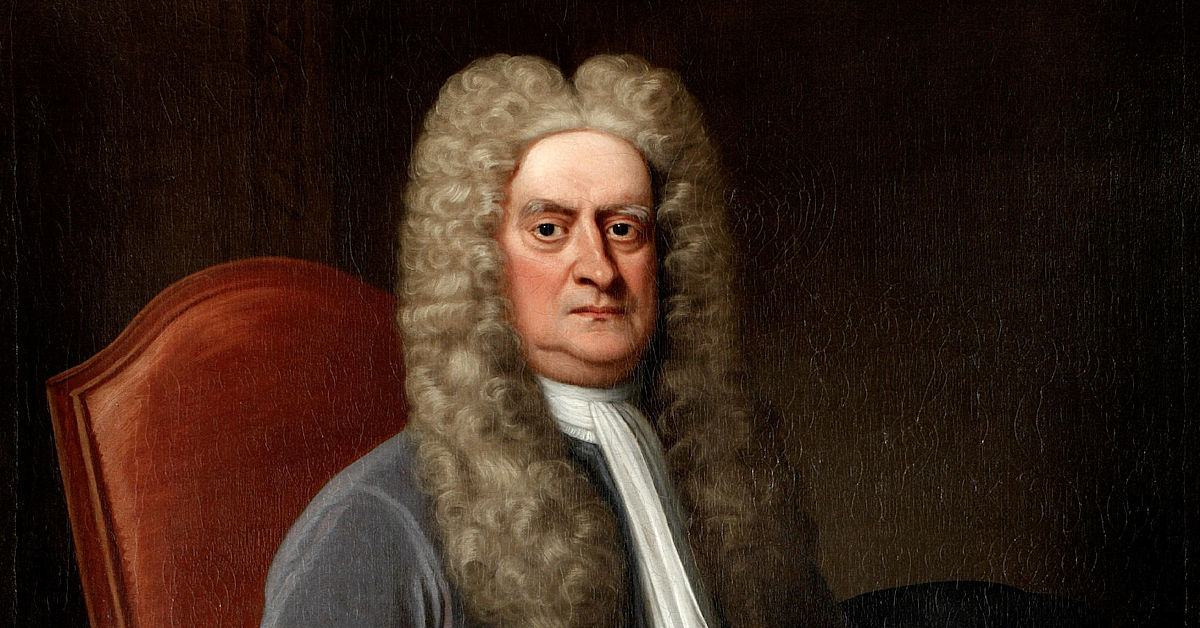
Ask anyone to name five well-known scientists, and Isaac Newton is almost certain to make the list. Born in 1643, Newton’s breakthroughs (most famously, his laws of motion and theory of gravity) put him at the pinnacle of 17th century scientific achievement. What you might not be aware of, though, are Newton’s religious beliefs and the secrecy he chose to maintain surrounding them.
By the time of Newton’s birth, European intellectual culture was shifting towards a newfound appreciation of the sciences. The 1600s saw major European breakthroughs in the fields of astronomy, human anatomy, magnetism, physics, and chemistry. At times, however, this progress elicited tension with Europe’s religious authorities.
Perhaps the most infamous incident of this period was the Catholic Church’s trial of Italian scientist Galileo Galilei, who was interrogated, silenced, and placed under life-long house arrest for his ‘heretical’ belief that the earth was not the centre of the universe. In similar fashion, the Pole Mikolaj Kopernik (Nicolaus Copernicus), who developed a theory of heliocentrism around a century earlier than Galileo, was opposed and mocked, sometimes furiously, by both Catholics and Protestants.
Newton’s deviance, on the other hand, was utterly theological. Newton, in private, did not believe that God was a trinity (that is to say, he rejected the claim that Jesus Christ and the Holy Spirit should be considered as ‘God’). Further, he rejected the practice of infant baptism, denied that human souls were naturally immortal, and dismissed the existence of the devil and demons.
Such beliefs were illegal to teach or publish under the Ordinance for the punishing of Blasphemies and Heresies, approved by England’s Parliament in 1648. Legally, these beliefs could be punished by death or imprisonment; in practice, the biggest danger was probably damage to one’s social reputation and career. Probably. Stephen Snobelen notes individual cases of hangings (in 1646 and 1697), imprisonment (in 1662, 1663, and 1703), book burning (in 1690 and 1693), and career repercussions (in 1668 and 1712) for various British ‘heretics’ and ‘blasphemers’.
Regardless, Newton was prudent about his religious views; he knew what was at stake, and so chose to entrust himself only to his own circles. This is not to say that he held his opinions meekly! Snobelen describes Newton as an active ‘theological networker’ and ‘private evangelizer’. Newton even went so far as to write a manuscript (An Historical Account of Two Notable Corruptions of Scripture) attacking trinitarian ‘corruptions’ of passages in 1 John and 1 Timothy. He intended it to be published anonymously with the help of his friends John Locke (in 1690) and Hopton Haynes (in 1709), although on both occasions he ultimately thought better of it.
Newton, of course, was not the only one beginning to flout Europe’s religious status quo. Across the continent, other non-conformists (whether deists, universalists, atheists, or otherwise) were growing bolder, more defiant, and more public with their opinions. For now, though, their stories — and the story of the period known as ‘the Enlightenment’ — will have to wait!
This is a modified excerpt from my as-yet-unreleased book, Decoding Gehenna: Hell and the Afterlife in the West. Subscribe or Follow Me for updates and more sneak-peek excerpts!
