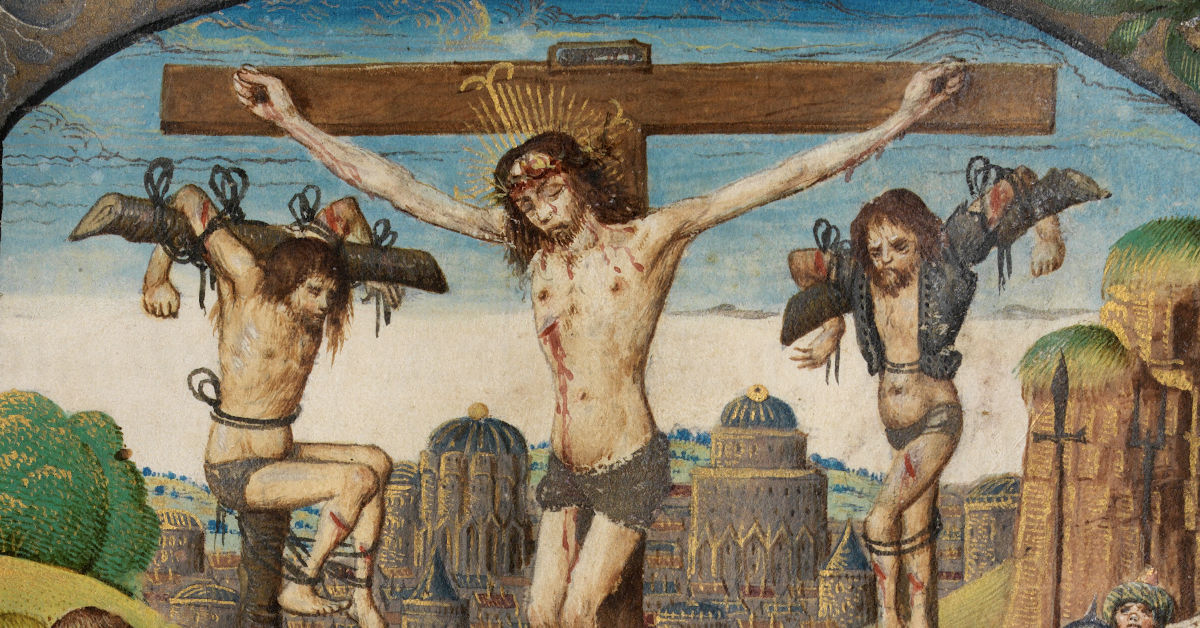
You know the scene well. The religious upstart, Jesus of Nazareth, has been crushed under the wheels of injustice, and now hangs upon a Roman cross. He is flanked by two criminals, condemned to an agonising and prolonged death. But then, a ray of hope — one of the miscreants appeals to the mercies of Jesus, and is met with the famous rejoinder: “Truly I tell you, today you will be with me in Paradise.”
The story of the crucified bandits bears some interesting similarities to the story of Legion, which I discussed in my last post. Both tales contain memorable, enigmatic characters; both, more intriguingly, highlight a difference in the attitudes of Matthew, Mark, and Luke towards the afterlife.
If you’re a fan of Bible trivia, you might already know that the ‘penitent thief’ only features in one of Matthew, Mark, and Luke; the other two books depict both criminals as belligerent towards Jesus (while the book of John mentions barely any details whatsoever). For those unaware of this fact, however, let me pose a question: out of Matthew, Mark, and Luke, which is the most likely to promise the crucified bandit an afterlife of immediate, conscious bliss?
(If you need a hint, go back and read about Legion again!)
Once you’ve locked in your answer, you can check out the solution for yourself here.
After reading these three versions of events, the immediate question is: Why would Luke add in an entire character seemingly out of nowhere? In the case of Legion, you may recall, Luke kept his story more or less consistent with Matthew and Mark; here, however, he diverges completely.
We can reject the explanation that the author of Luke just ‘happened’ to have the extra information on hand, just as we can reject the idea that the author of Matthew ‘happened’ to have access to Jesus’ speech about Judgment Day. These unique inclusions align far too well with their respective authors’ overarching spiritual messages.
I’ve heard it said that Luke consistently portrays a ‘generous, kind Jesus’ (as opposed to Mark’s ‘powerful Jesus’ and Matthew’s ‘fierce prophet Jesus’). This may go some way to explaining why Luke, and Luke alone, incorporates the story of the good bandit. However, I would argue that there is another, more evident reason: the author of Luke endorses some sort of currently-existing supernatural realms, and wants to emphasise this to his readers. We have already seen how Luke endorses belief in the abyss, a currently-existing demonic prison; it follows that he would believe in currently-existing supernatural realms for humans, too. This lines up nicely with the Parable of the Rich Man and Lazarus, found only in the book of Luke.
What, then, can be done about the apparent discrepancy between Luke and, say, Matthew or Mark? For a non-Christian observer such as myself, of course, such differences are a cause for curiosity rather than religious angst. ‘Progressive’ Christians might be comfortable admitting that Luke (or Matthew, or Mark) may have got some of the finer details wrong, and that inconsistencies are nothing to be afraid of. Many ‘conservative’ Christians, from my experience, see the differences as part of a coherent whole: human ‘souls’ or ‘spirits’ maintain some sort of consciousness after death, and a resurrection of bodies will occur on some kind of final Judgment Day.
Alternatively, in the case of the Jehovah’s Witnesses church, a more ingenious solution is available. For Luke’s story of the repentant criminal, their ‘New World Translation’ of the Bible enlists the aid of a most villainous comma — a linguistic hit-and-run — to render Jesus’ words as follows: “I tell you the truth today, you will be with me in Paradise.” Here, the crucial adverb today refers to the first clause (I tell you the truth), rather than the second (you will be with me in Paradise). Problem solved!
(Similar criticism could be levelled at the popular ‘New International Version’ and its treatment of 1 Peter 4:6; that, however, is a tangent I’ll leave for another time).
This is a modified excerpt from my as-yet-unreleased book, Decoding Gehenna: Hell and the Afterlife in the West. Subscribe or Follow Me for updates and more sneak-peek excerpts!
