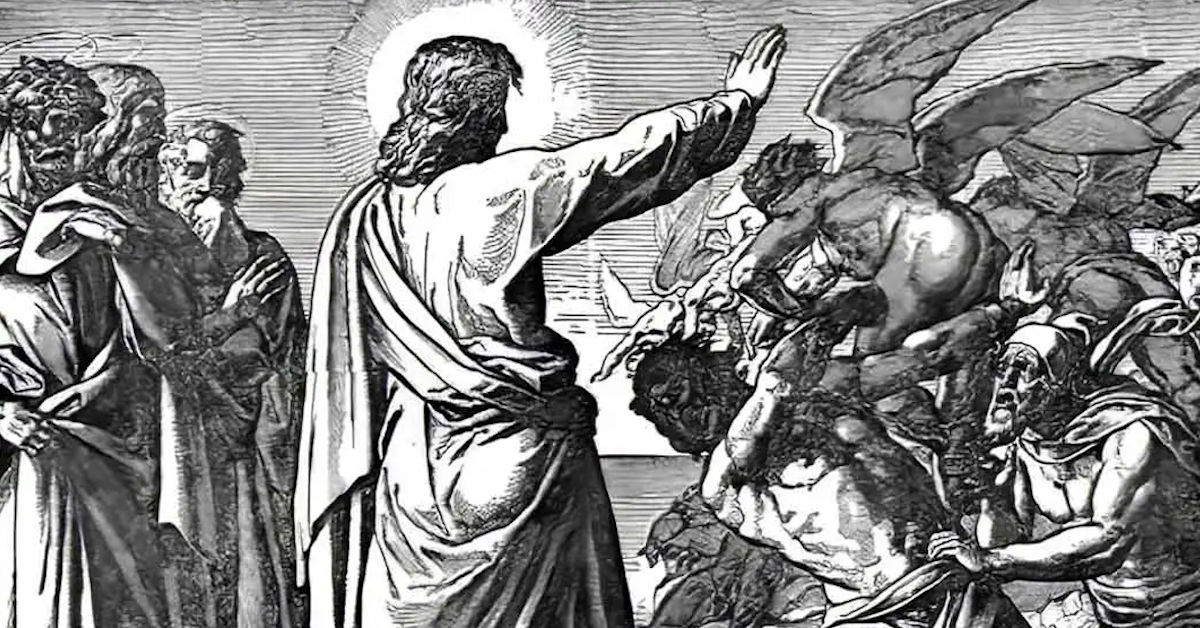
Picture this: you’re walking towards a notorious burial ground on the outskirts of town, drawing on every ounce of fortitude in your possession. You’ve heard stories of a dangerous, unruly man living among the tombs — a man unable to be chained down, or so the rumours say. From a distance, you hear a grotesque wail; then, a bedraggled figure approaches you, naked and bloodied. It’s him.
Of course, I’m talking about Legion, unique and captivating even among the Bible’s impressive cast of minor characters. On paper, the encounter would be entirely believable as some sort of gritty Dark Souls: New Testament Edition boss fight: Legion, Demonic Collective of the Ten Cities (watch out for the herd of pigs!).
Our purpose today, though, is not that of a character study; rather, I want to focus in on one particularly curious line from each version of the tale (Mark 5:1-20; Luke 8:26-39; Matthew 8:28-9:1). If you feel like indulging me in a little game of ‘spot the difference’, take a couple of minutes and see if you can work out what I’m getting at. What seemingly trivial detail varies between all three stories?
It’s okay, I don’t mind waiting 🙂
If you answered that Matthew doesn’t identify the demon by the name ‘Legion’, and instead notes that there were two demon-possessed men… good effort, but that’s not quite what I had in mind! After all, I asked about a detail that varied between each of the versions. No, what differs between Mark, Matthew, and Luke is this: what is Legion afraid of? This is where things get interesting.
Mark simply states that Legion is terrified of being “tormented” by Jesus; nothing more, nothing less. Matthew writes that the demons are terrified of being tormented “before the time” (emphasis added). In Luke’s story, however, Legion begs Jesus “not to order them to go back into the abyss” (emphasis added).
Why did Matthew, Mark, and Luke tell the story differently? The key is that the events within these books are purposefully arranged and told in order to communicate a particular spiritual message. Mark’s purpose is simply to demonstrate Jesus’ power and authority; the afterlife is of far lesser importance. Matthew is concerned about warning his readers of a future time of resurrection and judgment in the afterlife (that is, “the time“). In contrast, Luke’s understanding of reality includes the seemingly currently existing supernatural realms of Hades and Paradise, as well as abysson (the abyss).
Between the books of Luke and Revelation, it is possible construct a basic portrait of abysson within late-first-century Christianity. It is a supernatural realm where demons are locked away. It is not a place where humans are sent to. Also, it is not the final place of punishment for demons; rather, it functions more like a temporary demonic prison. Jude (written sometime between AD 70-125) and 2 Peter (written around AD 125-150) describe a similar concept, without using the word abysson.
The emergence of abysson as a demonic prison can be attributed to the successful influence of Jewish writings such as the Book of Jubilees (written in the late second century BC) and 1 Enoch (written in the third century BC). According to the mythology of these writings, demons originated in the days of Noah, when angels descended from heaven, had sexual relationships with human women, and corrupted humanity in various ways. God retaliated by imprisoning these ‘fallen angels’. Strong comparisons can also be made to the traditional Greek religious concept of Tartarus (especially given 2 Peter’s use of the word tartaros — the only time this word appears in the entire Bible!).
Interestingly, the concept of abysson as a demonic prison does not appear in the earliest Christian traditions. Paul’s earlier usage of ‘the abyss’ in Romans 10:7 (written around AD 55-57) is more or less the same as the sheol-hades of the Jewish Scriptures, the ‘realm of the dead’. Nevertheless, by the end of the first century AD, the mythology of Jubilees and 1 Enoch had become an accepted part of Christian religious belief.
And so, what might seem at first like throwaway lines — the panic-stricken words of Legion to Jesus — are, in fact, deeply revealing. They provide robust confirmation of what can be observed elsewhere in Matthew, Mark, and Luke, namely: Matthew’s consistent focus on the Jewish Scriptural concepts of ‘the time to come’ and gehenna; Luke’s mentioning of currently existing supernatural realms, belief in which can be further observed in other late-first-century Christian writings; and Mark’s no-nonsense disinterest in afterlife specifics altogether!
All of this naturally raises further questions. What did Matthew mean by ‘the time to come’, and what Jewish traditions was he drawing on? What on earth is sheol-hades? And what else did Luke have to say about supernatural realms? Some of these points will be touched on in future posts; others will be expanded upon in the final version of Decoding Gehenna. For now, you’ll just have to wait and see!
This is a modified excerpt from my as-yet-unreleased book, Decoding Gehenna: Hell and the Afterlife in the West. Subscribe or Follow Me for updates and more sneak-peek excerpts!
